Do Fogboard puzzle generators call any backend API or server?
No. Every puzzle generator, deterministic FNV-1a + Mulberry32 date seed, uniqueness counter, and hint analyzer runs 100% locally in plain JavaScript inside your browser tab with zero server calls.
What is the difference between a unique-solution proof and a zero-guess proof?
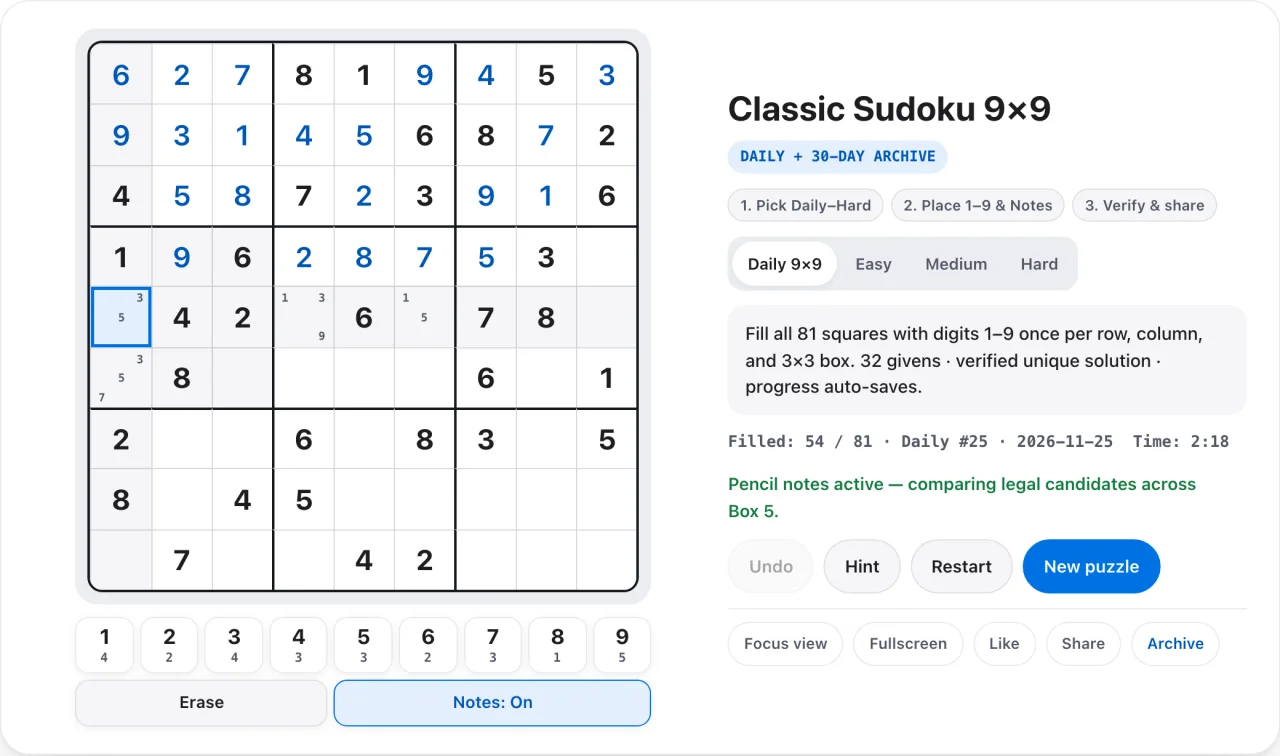
A unique-solution proof (used on Classic Sudoku 9×9, Mini Sudoku 6×6, Queens Puzzle, Zip Game, Shikaku, and Slitherlink) proves mathematically that strictly one valid completion exists. A human-logic zero-guess proof (used on No Guess Minesweeper and Nonogram) goes further by verifying that our explicit human-style deduction rules solve the board from start to finish without guessing.
How fast does Fogboard generate a verified Classic 9×9 Sudoku?
In our reproducible 100-board Node.js V8 benchmark across all four tiers, every board verified 100/100 unique with average generation times of 0.15ms (Medium), 0.16ms (Daily), 0.22ms (Easy), and 0.76ms (Hard), with a worst-case maximum of 2.88ms.
How does the 30-Day Daily Archive work without a server database?
Every daily board is derived deterministically from its ISO calendar string (YYYY-MM-DD in UTC for English games or JST for Japanese games). Selecting a past date inside the Archive drawer re-runs that exact seed locally in milliseconds, while localStorage tracks which dates you cleared.
Which Fogboard games auto-save unfinished boards across a page refresh?
Our three flagship deep-board games—Classic Sudoku 9×9, Zip Game, and Queens Puzzle—automatically save your active board state and elapsed timer in localStorage after every move, restoring your exact session on reload. All 11 English and 3 Japanese titles also save daily completion checkmarks locally.
Does Fogboard claim Battleship Online is a no-guess puzzle?
No. We explicitly classify Battleship Online as a fog-of-war radar strategy game played against a probability-density AI rather than a deterministic grid proof, because hidden ship placement inherently involves probabilistic hunting.
What happens if a generator hits its attempt limit on an unusual seed?
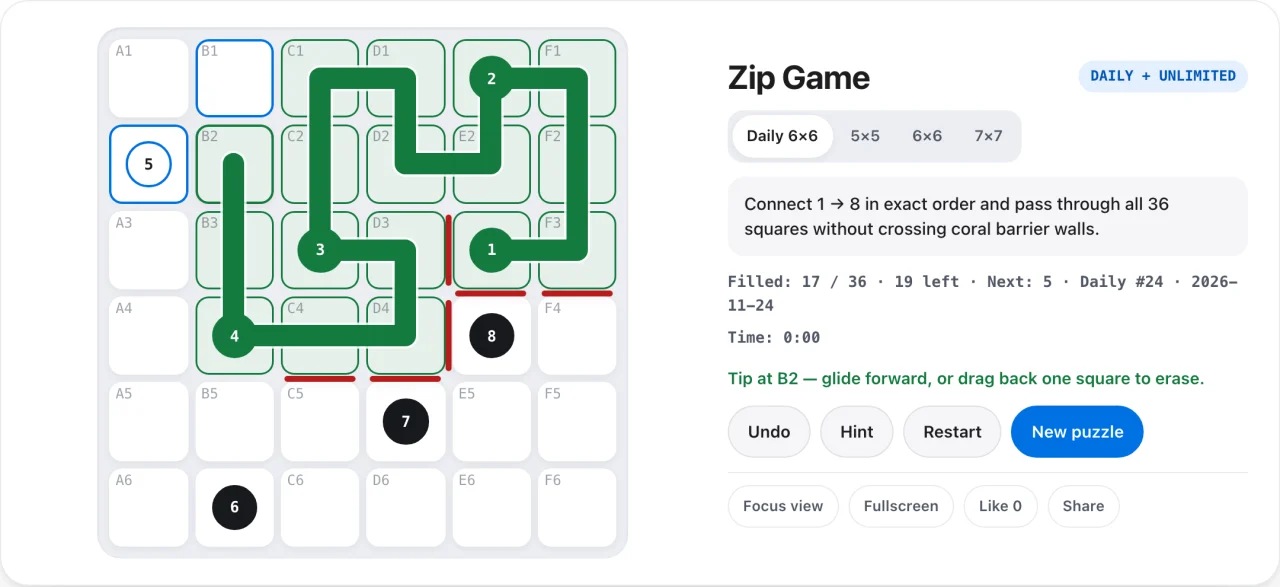
Every bounded loop (such as Queens’ 600 attempts, Minesweeper’s 500 attempts, or Zip’s 4 candidate seeds × 28 passes × 90,000-step DFS cap) includes a safe fallback or deterministic repair step so your browser never hangs or freezes on low-power mobile CPUs.
Can I inspect Fogboard’s solver code myself?
Yes. Every puzzle engine runs unbundled directly inside the page in your browser—you can open DevTools on any game page to audit the FNV-1a hash, Mulberry32 PRNG, bitmask solvers, and localStorage keys yourself.